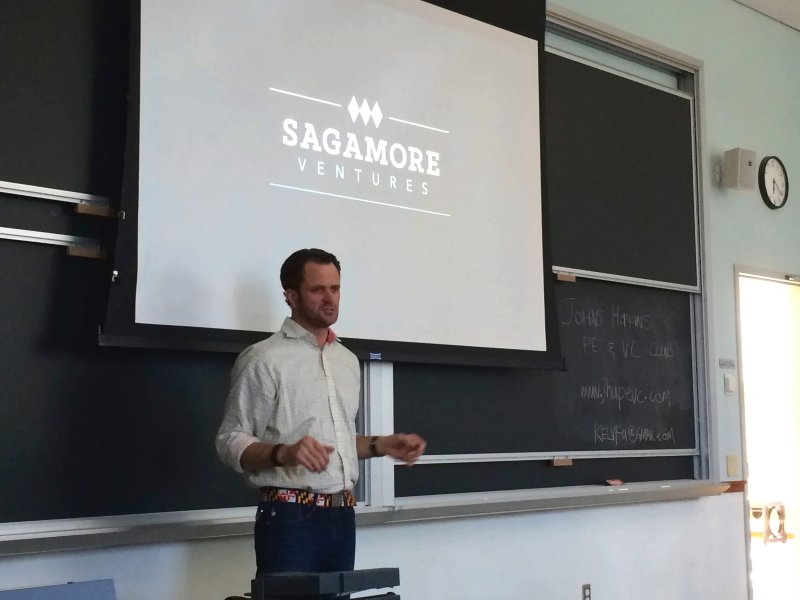
The facts
- Date
- April 13, 2016
- Where
- Johns Hopkins Homewood campus, the Club’s first event there
- Speaker
- Demian Costa, Managing Partner, Sagamore Ventures
- Investor
- Sagamore Ventures, a division of Plank Industries, the family investment arm of the chairman and CEO of Under Armour
- Asset
- City Garage, Port Covington, Baltimore
- Idea
- A “Product Hub” for physical-product companies
How it unfolded
1. Finding the gap
The team analysed the work spaces and incubators in Maryland and found that many supported technology companies, but few supported companies that build physical products.
2. Sizing the problem
An internal study found that making one pair of running shoes involved up to 150 pairs of hands. That kind of manufacturing was labour intensive and the local workforce was not equipped for it, so many U.S. companies outsourced it to other countries.
3. Building the asset
Working with Under Armour, Sagamore Ventures broke down the manufacturing process to make it leaner, and built new manufacturing facilities at City Garage called The Under Armour Lighthouse.
4. The tenants
Other occupants include the Foundery, a makerspace with industrial-grade tools; READY Robotics, a Johns Hopkins-affiliated startup making robotic automation for manufacturers; and Bustin Boards, a custom longboard company.
5. Choosing who comes in
Two questions decide who qualifies for space: how much economic impact the company will have on the local community and region, and how it will help the City Garage community through its engagement with companies already there.
What to take from it
- An investment thesis can start from a gap in what already exists, not from a trend.
- A study of one product’s supply chain can turn into a business case for a place.
- An investor can have a regional objective, jobs and wealth for the community, alongside a financial one.
- Selection criteria show the thesis: here, economic impact and community engagement.
Try it yourself
List two criteria another regional investor might use to choose tenants for a shared industrial space, and say how they differ from City Garage’s two.
Source and terms
Built from the Club’s recap: Investing and Nurturing Entrepreneurship in Baltimore and the Region. Figures and descriptions are as given in the recap of the talk.
Terms used: Incubator · Family office