University and city leaders discuss recent report from Johns Hopkins’ 21st Century Cities Initiative
By Luke LaVoie / Published Oct 24, 2017 / JHU Hub
Download the full report here.
The Johns Hopkins Carey Business School hosted an event at the school’s Harbor East campus last week to present and discuss a comprehensive report analyzing the strengths and limitations of the financing ecosystem within Baltimore. The event attracted top academics, regional business executives, and civic leaders, and featured Ronald J. Daniels, president of Johns Hopkins University; Baltimore Mayor Catherine Pugh; and Bernard T. Ferrari, Carey’s dean.
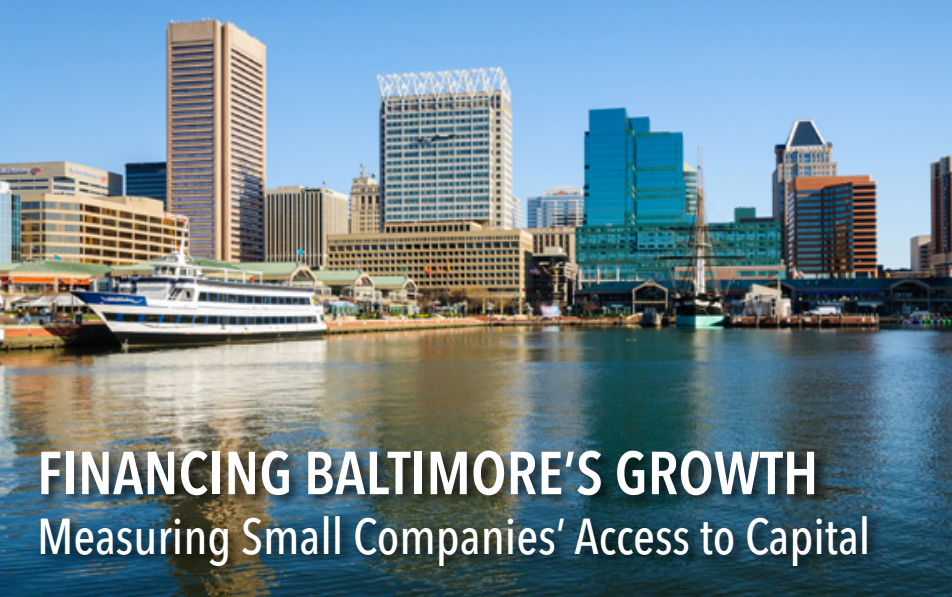
The report, “Financing Baltimore’s Growth: Measuring Small Companies’ Access to Capital,” attempts to examine and answer key questions around the sources, gaps, and availability of capital for small businesses.
Daniels said the report was an example of how Johns Hopkins can be an agent of change within the city by promoting research and ideas that can be translated into action.
“We can be a partner in catalyzing research that helps drive decision making about our city’s future,” Daniels said. “Research that takes a dispassionate and data-driven look at the challenges we face. … Research that can discipline debate and shape effective interventions, policies, and programs to address identified needs and amplify our city’s strengths.”
Pugh, touting her roots in business as a banker and business owner, said small businesses are “the backbone of any city, state, and of this country.”
She added: “I believe this study is comprehensive, but more importantly, it provides a pathway for you all to look at how we increase the opportunity to finance additional businesses in this city. I look forward to this report, but more importantly how we partner in the future.”
The report was produced as part of Johns Hopkins’ 21st Century Cities Initiative, a universitywide effort that connects researchers, policymakers, and practitioners to produce data-driven solutions to a variety of challenges facing modern cities. The report was crafted by three lead authors: Mary Miller, a visiting senior fellow; Ben Siegel, the executive director of the initiative; and Mac McComas, the program coordinator.
The authors offered four recommendations for strengthening the economic ecosystem of Baltimore:
- Enhance measuring, tracking, and reporting systems for capital
- Increase the connection and conference between businesses and investors
- Build more lending capacity via a three-pronged public and private approach
- Expand the range of financial institutions within the city
Ferrari said the report was the first step in identifying avenues to better unlock “the intellectual and human capital” of the city.
“When I first came to Baltimore six years ago, I felt that I had come to a city [that] is a unique nexus of culture, education, research, and industry, but whose business light has been a bit under a bushel,” he said. “It is time for us to let our light shine to a fuller potential.”